Keeping a Three-Rail Ranch Fence Straight Over a Long Run
A ranch fence earns its keep on how well it holds a straight line across a property, not on any single post.
August 27, 2026 · 3 min read
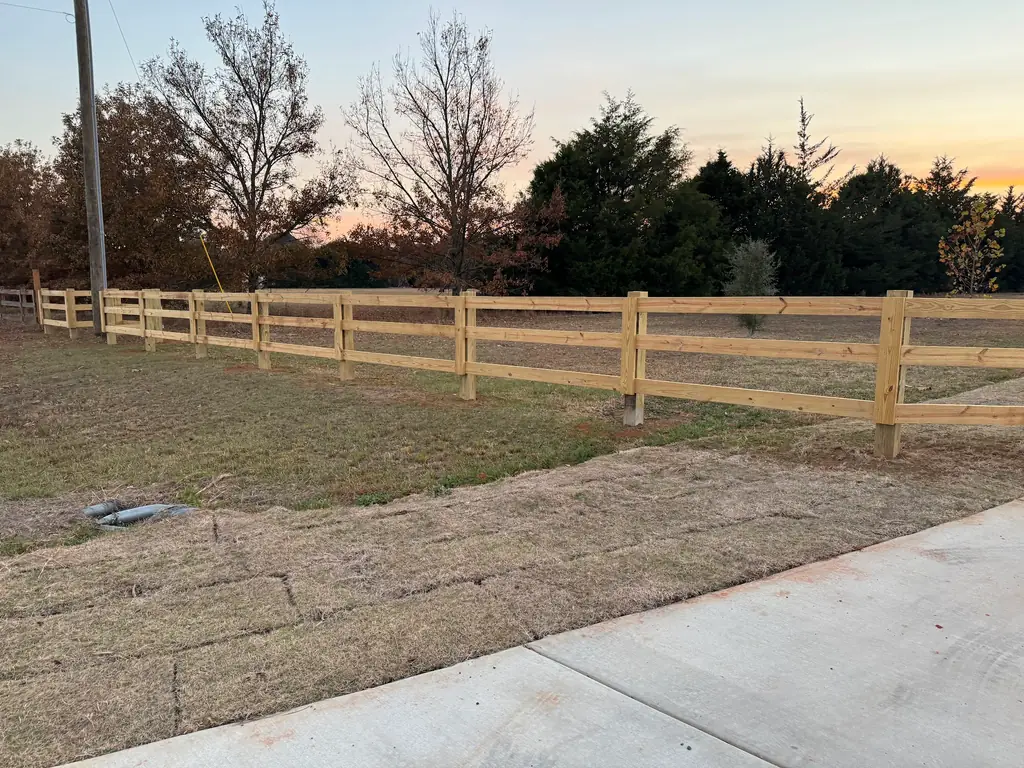
There's something about a three-rail ranch fence running straight across a field that looks effortless, and that's exactly why it's easy to underestimate what it takes to build one that stays that way. A short run of ranch fence along a driveway is forgiving. A run that stretches across acreage, following the natural rise and fall of the land, is a different job. Every post has to carry its share of the line, and if even a handful of them are set wrong, the whole fence reads as crooked from the road even when most of it is fine.
Line Posts Carry More Than They Look Like They Do
A three-rail fence relies on its line posts staying plumb and evenly spaced far more than a solid privacy fence does, because there's nothing filling in the gaps to hide a post that has drifted out of line. Over a long run, spacing has to be consistent enough that the rails sit level from post to post, and depth has to be consistent enough that clay movement doesn't lift one post half an inch above its neighbors. On acreage that rolls even slightly, that means checking grade as you go rather than assuming the ground is flat just because it looks that way standing at one end.
Corner and End Posts Do the Real Work
The line posts hold the rails up, but the corner and end posts hold the whole fence together. Every rail that runs into a corner post is pulling on it, and over a long enough run that pull adds up. A corner post that's undersized or not set deep enough will lean inward over a few years, and once one corner starts to go, it pulls the tension out of everything attached to it. This is why a corner post on a long ranch run is almost always set larger and deeper than the line posts next to it, even though from a distance they look like the same fence.
Rail Length and Sag
Wood rails sag a little over time no matter how they're installed, but how much they sag depends on span length and how the rail is fastened at each post. Rails that run too far between posts without enough support will bow visibly within a couple of years, especially the top rail, which takes the brunt of sun and rain. Keeping spans within a reasonable length and fastening rails solidly rather than just nailing through the face keeps that sag from showing up early. It's a small detail that makes a big difference in how the fence looks from the road ten years in.
- Consistent post depth across the whole run, adjusted for any grade change
- Larger, deeper posts at every corner and gate opening, not just line posts
- Rail spans kept short enough that they don't visibly bow under their own weight
- A walk of the whole line before install to note where the ground actually rises and falls
Reading the Ground Before You Start
On acreage, the biggest mistake is treating the whole line as one flat project instead of walking it first. Low spots collect water after a hard rain and can undermine a post over a few seasons if drainage isn't considered up front. High spots and rock can make standard post depth impossible in places, which means adjusting the plan rather than forcing it. None of this shows up until you actually walk the property end to end with an eye for where the ground does something different. A fence line planned around those changes ages a lot better than one that ignores them and hopes the ground behaves.
Building for the Long Haul
A three-rail ranch fence is meant to be a low-maintenance, long-term boundary, and it earns that reputation when it's built with the whole run in mind rather than post by post. Jones Custom Fences has built ranch fence across Houston County and the surrounding middle Georgia area for years, on properties with the kind of rolling ground that makes a straight line harder than it looks. If you're planning a long run and want it to still look right in ten years, that's worth talking through before the first post goes in the ground. Call (478) 550-3824 for a free estimate.
Jones Custom Fences, (478) 550-3824
Call (478) 550-3824More articles
Wood, Vinyl or Chain Link for a Georgia Back Yard
Every fence material does something well and something poorly, so the right choice comes down to what your yard actually needs from it.
Why Fence Gates Fail First, and What Makes One Last
A gate does more work than any other section of fence, so it needs to be built differently, not just hung on the end of the line.